Permaenergy
Global Decentralised Ecologically Integrated Energy Infrastructure
Decentralised Ecologically Integrated Energy Infrastructure represents a radical shift away from vulnerable, top-down utility monopolies toward a worldwide network of localised, self-sustaining micro-grids. Within the Permaenergy Framework, this means replacing massive, extractive power plants and fragile transmission lines with distributed, Ecologically Integrated Nodes that are owned and operated by the communities they serve.
Who We Are
We are the driving force behind the Permaenergy Framework, a strategic approach focused on building smart, resilient, off-grid microgeneration infrastructure. As framework integrators, we bridge the gap between advanced renewable technology—such as highly engineered solar photovoltaic (PV) arrays and Battery Energy Storage Systems (BESS)—and whole-systems ecological design. Through rigorous engineering and a deep commitment to Permaculture Principles, we ensure that human habitats operate in mutualism with the biosphere.
Our Mission
Our mission is to empower communities to achieve absolute resource sovereignty. We engineer and deploy holistic solutions that secure the Water-Energy-Food (WEF) Nexus. By addressing energy autonomy, food sovereignty, and water security, we transition rural, marginalized, and urban populations from passive consumers into active prosumers.
How We Work:
Permaenergy Node Architecture
Permaenergy Nodes:
The Fundamental Building Blocks
A Node is the baseline architectural unit of the Permaenergy Framework. It is the physical, self-sustaining technical footprint that secures the Water-Energy-Food (WEF) Nexus for a specific location.
- The Concept: Think of a Node as a single, self-reliant cell. It is the foundational building block of your decentralized grid.
- The Application: Every installation we build is inherently a Node, whether it is a small residential grid-interactive setup (U-Node) or an off-grid agricultural microgrid (R-Node).
- The Focus: The primary focus of a Node is technical and ecological autonomy—generating power, capturing water, and growing food for its immediate footprint.
Urban Nodes (U-Nodes)
Designed for high-density environments, focusing on grid-independence and urban resilience. These nodes utilize grid-interactive power capable of safe islanding during municipal blackouts, alongside space-efficient WEF integrations like vertical hydroponics, rooftop agrivoltaics, and indoor biological air purification through phytoremediation.
Rural Nodes (R-Nodes)
Engineered for complete off-grid autonomy in remote or agricultural landscapes. These nodes incorporate robust, hybridized microgrids, large passive solar greenhouses, and deep-well solar pumps to provide complete independence and broad-scale WEF resilience. Our flagship initiatives include the deployment of Smart Modular Energy System Solution Hubs, state-of-the-art technical research and training facility implemented inside the existing Educational Institution
Regardless of whether a system is a U-Node or an R-Node, they both share the exact same Permaculture Ethics: Earth Care, People Care, and Fair Share. They both calculate the absolute minimum base load for human security, and they both prioritize open-source hardware to prevent elite capture of essential resources.
Permaenergy Framework R-Node Integration
The Base Line:
A vulnerable Rural settlement
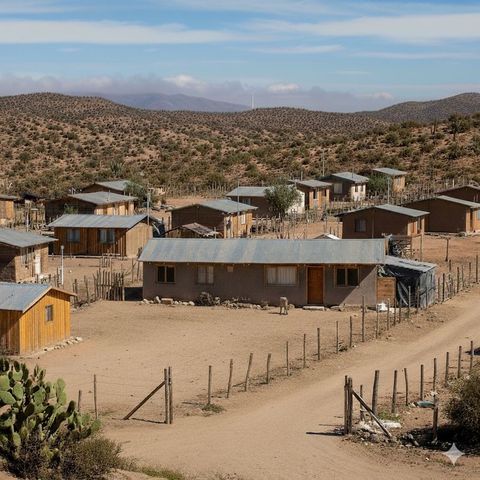
The image displays a remote, arid community situated in a harsh, dry landscape. The settlement consists of basic structures with corrugated metal roofs and dirt surroundings, characterized by sparse scrub vegetation.
Through an infrastructural lens, this village represents extreme vulnerability. It appears completely disconnected from centralized utilities, lacking visible localized energy generation, water retention systems, or structured agricultural production. The community is entirely exposed to climate extremes and likely reliant on external, high-emission supply chains for basic survival needs.
The Permaenergy Transformation:
A resilient R-Node
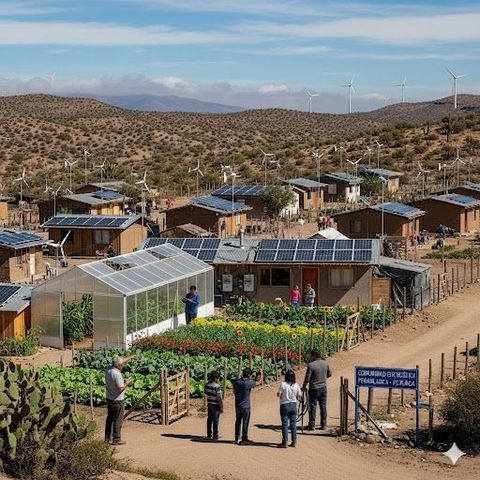
The new image illustrates the successful application of the Permaenergy Framework, transforming the vulnerable settlement into a thriving, self-sustaining Smart Modular R-Node.
The transformation shifts the settlement from a state of passive survival into a highly adaptive, ecologically integrated community engineered for long-term climate change resilience.
Here is how the framework's ecological and engineering principles drive this visible transformation:
Decentralised Energy Autonomy (catch and store)
The barren rooftops have been retrofitted with modular solar photovoltaic (PV) arrays, supplemented by a network of distributed micro-wind turbines. This hybridization ensures consistent base-load generation regardless of weather fluctuations. The main building in the foreground features wall-mounted inverters and battery energy storage, indicating a localized microgrid that provides absolute energy independence without reliance on centralized transmission lines.
Food Sovereignty & The WEF Nexus
The previously dusty, unproductive dirt has been engineered into a high-yield agricultural zone. The prominent integration of a large passive solar greenhouse physically decouples the community's food supply from external logistical chains, extending the growing season and protecting crops from the harsh arid climate. Adjacent open-air garden beds demonstrate deep Water-Energy-Food (WEF) integration, likely supported by solar-powered irrigation and rainwater retention.
Subsidiarity & Social capital
The presence of engaged individuals actively managing the greenhouse and agricultural plots reflects the critical social pillar of the framework. A community sign establishes local identity and ownership. This visually confirms the transition of the residents from passive, vulnerable inhabitants to active prosumers, supported by democratic maintenance and localized technical knowledge.
How can we help you?
SERVICES
Global Decentralised Energy Infrastructure
We design, engineer, and implement localised, self-sustaining microgeneration networks (Permaenergy Nodes) across vastly different global environments, from dense urban corridors to remote rural landscapes.
WEF Nexus Engineering
We physically secure the Water-Energy-Food Nexus for communities worldwide by integrating advanced renewable hardware (solar PV and BESS) with biological systems, such as passive solar greenhouses, rainwater extractors, and phytoremediation setups.
International capacity Building
We establish state-of-the-art technical training and research hubs in partnership with global academic and developmental institutions to transition populations from passive consumers to active, technically proficient prosumers.
We get it done
Why Us?
Every project comes with its own needs and challenges. Tell us your priorities, and we'll fill them to your satisfaction.